
Leaf spring
Like other springs, the leaf spring's task is to store, dampen and release energy – but it does so through a design in flat or strip material. The design is often governed by how the spring is to be integrated into the construction and the spring characteristics you are aiming for.
At EWES, leaf springs and strip parts are always tool-bound and customised. By involving us early in the project, we create a solution that is optimised both functionally and economically.
Leaf springs for strength and flexibility
The leaf spring is used when you need a compact solution with a defined spring rate and high load-bearing capacity. It works through bent angles and is well suited where space is limited but the strength requirements are high.
At EWES, leaf springs are dimensioned with the right material thickness, geometry and heat treatment to ensure correct function and long service life.
You get a robust component that withstands repeated loading without losing precision.
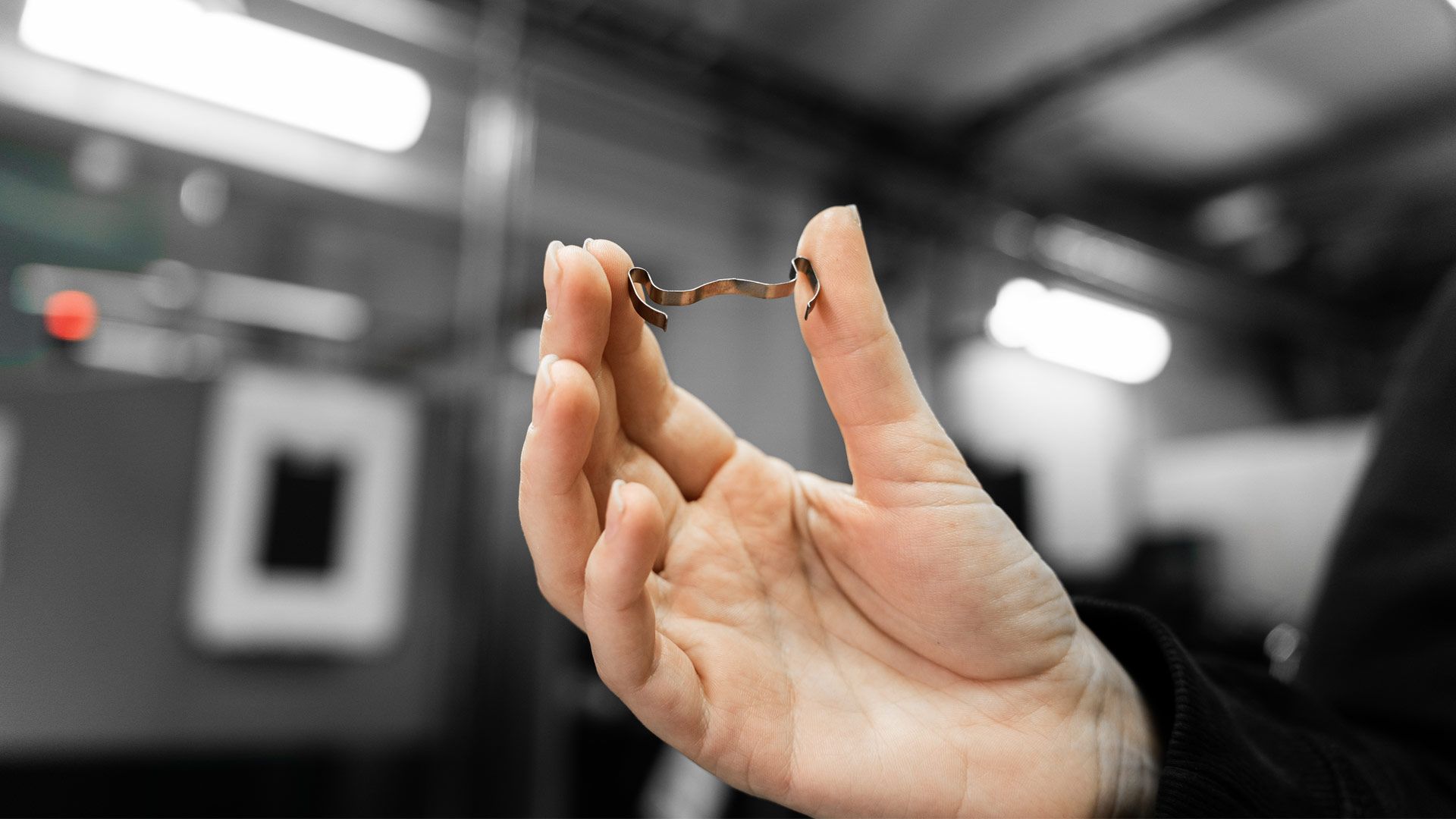
Design the leaf spring right from the start
By adapting the leaf spring to your application, you optimise both performance and cost over time.
Calculating force and durability for a leaf spring can be challenging
When it comes to leaf springs, reality is often more complex than theory. Unlike many other spring types, it is considerably harder to calculate exact force and strength in advance. This almost always means that we need to work with prototypes before we arrive at the right design.
Here we have a big advantage at EWES. With a strong prototype operation, we can quickly develop and test new variants. When the need arises, we can also use other units within the group, which provides flexibility both technically and commercially.
But sometimes the result still doesn't turn out as planned. In one project I was involved in, we felt confident about the design of the leaf spring, but at a later stage it turned out that it did not deliver the required force. We then had to go back and analyse the part again to understand how we could adjust the design and achieve the right force level. In situations like these, it is invaluable for us to see how the spring is mounted and how it actually works in the application.
The better we understand the whole picture, the better-informed decisions we can make and the more reliable the end result.
It was an intense period of testing, discussions and joint reviews on site with the customer. In the end, we arrived at a combination: increased material thickness and an adjusted angle to reach the right force level. After a long and at times quite stressful journey for both us and the customer, we now have a part that works as it should, ready for series production.
For me, this is a clear example of what real projects require. Theory, drawings and initial calculations are not always enough. You need to be prepared to reconsider, test again and sometimes take calculated risks. And above all: stay with the customer all the way until the solution works.
– Oscar Lönnblom, Sales and Engineering at EWES

Do you have questions about leaf springs?